Module 02 · Setting up GoSoft
Sales and late fee settings
Defaults for the reservation and the payment plan, what the salesperson can edit, required customer data, the marketing questionnaire, receipt printing and each project's late fee setup in GoSoft.
Every real estate company sells its own way: some ask for 10 % down, others 20 %; some charge interest and others don't; some let the salesperson negotiate and some don't. The sales settings keep those rules so every reservation starts with the right values.
- Set the defaults for the reservation and the plan.
- Decide what the salesperson can and can't change.
- Configure a project's late fee: type, value and grace days.
Global or per project
Settings can be global (for all projects) or specific to a unit. A unit without its own settings uses the global ones. That way you can have a general rule and exceptions for a special project.
What is configured
| Group | What it sets |
|---|---|
| Reservation | Default amount, validity days (default and maximum) |
| Down payment | Percentage or amount, days until due |
| Installments | Default and maximum number, frequency, days until the first installment |
| Interest | Type (monthly %, yearly % or fixed amount per installment) and default value |
| Edit permissions | Edit property price, Edit interest, Edit installment amount, Edit date of installment 1, Edit payment date, Edit exchange rate |
| Customer form | Which data is required to quote, to reserve and to complete the sale |
| Questionnaire | Which marketing questions the customer is asked (how they heard about it, reason to buy, occupation, income…) |
| Printing | Paper size, receipt template and colors |
| Terminology | What your country calls the block, the lot or the neighborhood unit |
A default only saves work: it appears when the reservation is created and the salesperson can change it. Only a permission set to No blocks: with Edit interest = No, no one can change the interest value or type.
Each project's late fee
The late fee is set on the unit's card, with Configure late fee:
| Type | How it is calculated | Example |
|---|---|---|
| Fixed amount per day | Value × days late | 5,000 per day × 12 days = 60,000 |
| % of the overdue installment, per day | Installment balance × % × days late | 2,000,000 × 0.1 % × 12 = 24,000 |
| Superintendency (Colombia) | The month's maximum late rate published by the Financial Superintendency, on overdue principal | Updates itself every month |
Grace days are the tolerance: if the customer pays within them, there's no late fee. After them, the fee counts from the first day late.
Write the late fee rule in the contract with the same words as the settings: "5,000 for each day late, after 5 grace days". When the customer asks, the receipt will show exactly that calculation.
In GoSoft, step by step
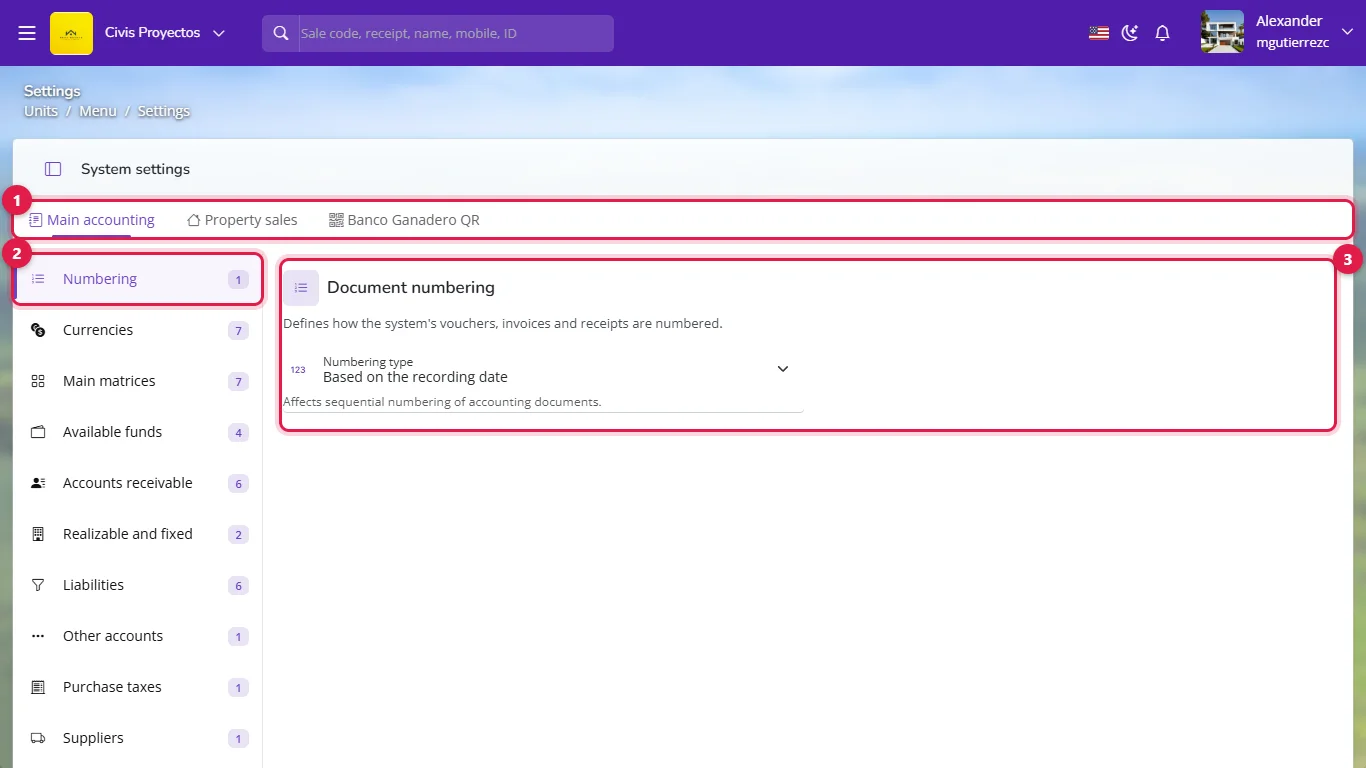
Open Settings in the Main strip and go to the sales settings. Choose Global or the unit.
A project's sales settings Complete reservation, down payment, installments and interest. Review the edit permissions.
In Customer form, mark the required data; in Questionnaire, the questions the salesperson will see.
Save with Update config.
For the late fee, open My company, find the project's card and click Configure late fee: choose the type, the value and the grace days.
Self-assessment
The settings say 24 installments by default. Can the salesperson build a 36-installment plan?
Yes, if it doesn't exceed the configured maximum: the default is not a limit.
Which permission stops the salesperson from changing the rate?
Edit interest set to No.
Late fee of 5,000 per day with 5 grace days. The customer pays 3 days late. How much late fee?
None: it's within the grace days.
And if they pay 8 days late?
8 × 5,000 = 40,000, because after the grace days it counts from the first day.